Skip to main content
This site uses cookies for ad optimization and service analytics. Privacy Policy
The Hermit
Major Arcana
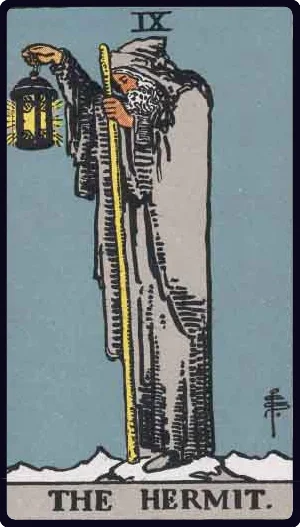
Upright keywords:
Reflection
Solitude
Wisdom
Reversed keywords:
Isolation
Loneliness
Withdrawal
Meaning of The Hermit
Upright
Like the old man holding up a lantern on the mountaintop, this card is about stepping away from people to find the answer within yourself. Some things become visible only when you step back from busy relationships and noise, and the six-pointed star inside the lantern means the answer isn't out there but already within you. It's a time when being alone is not loneliness but a way of getting your thoughts in order, so it's right not to rush decisions.
Reversed
These are the two ways withdrawal turns into escape: time alone stretches on so long that you're cut off from people, or, conversely, you run into busyness and leave no time to face yourself. Stubbornly blocking others' advice with “I know better” comes from the same root, so in this period you need to settle on one of two things: come down from the mountain, or climb it.
The Hermit — Daily Fortune
Upright
Core
It's a day when time alone gives you more than time with people.
Detail
If plans get canceled or a quiet afternoon opens up, that's today's gift. Tidying up what you've put off, walking alone, or a book you haven't picked up in a long time all suit the day, and a thought that comes to you today tends to become next week's decision.
Advice
Spend one hour alone today without your phone. In the evening, write down one line about what came to mind during that time.
Caution
If you ignore messages on a day you want to be alone, the other person will read it as “is something wrong?” Just send one line: “I'm taking it easy today.”
Reversed
Core
It's a day when being alone doesn't help you sort things out, or when you keep yourself forcibly busy because you don't want to be alone.
Detail
It takes the form of staying in your room staring at a screen until evening, or, conversely, of making any plans at all just to be around people. Both are ways of avoiding facing yourself.
Advice
Today, sit for just ten minutes without putting anything on. If it feels uncomfortable, that's what you need to look at.
Caution
If “I've always been more comfortable alone” goes on for days, it's not comfort; you're hardening.
The Hermit — Love
Upright
Core
It's a time to look into your own heart before looking at the relationship.
Detail
If you're in something unofficial, you first need to sort out “what kind of relationship do I really want” before the next step becomes clear; if you're dating, respecting each other's time apart deepens the relationship. If you're single, it's a time when closing the book on a past relationship takes priority over meeting someone new.
Advice
Write down one pattern that kept repeating in past relationships. That becomes your criterion for choosing the next person.
Caution
If your time alone sorting things out goes on too long, the other person will read it as your feelings cooling. Put a deadline on “I need time to think.”
Reversed
Core
You're rushing into a relationship out of loneliness, or your heart is so closed that the other person can't get near.
Detail
It takes the form of starting something with someone who isn't right because you don't want to be alone, or, even while dating, of not sharing what's inside so that the other person feels a wall. Shutting down a conversation first with “you wouldn't understand anyway” is a common scene in this period.
Advice
Tell the other person one thing you've been thinking about on your own lately. Even if you aren't understood, the act of saying it lowers the wall.
Caution
A relationship that begins out of loneliness ends when the loneliness fades. Take new encounters slowly in this period.
The Hermit — Relationships
Upright
Core
It's a time when, rather than a wide circle, one or two deep relationships remain.
Detail
Gatherings get fewer and contact thins out, but that's a sorting-out, not a loss. It's a time to seek out “someone holding a lantern” — a long conversation with an old friend, a meeting with an elder whose advice you want — and you may become someone else's lantern, too.
Advice
Ask one person whose wisdom you'd like to borrow to meet sometime this month. If you say “I'd like your advice,” most people will make the time.
Caution
If you don't say anything while pulling back, relationships get cut off. One line — “I'm keeping to myself a bit lately” — preserves the relationship.
Reversed
Core
It's a time when isolation drags on, or when you block others' advice and reach conclusions alone.
Detail
It takes the form of cutting off all contact and then having no one to call when you need someone, or of pushing away the concern of those around you as “interference.” At work, it shows up as trying to do everything yourself until collaboration stalls.
Advice
Reply, even briefly, to the person you've left unanswered the longest. The relationship isn't broken; it's paused.
Caution
“I don't need advice” usually comes out exactly when you need it most.
The Hermit — Marriage
Upright
Core
It's a time to set your own standards without rushing into marriage.
Detail
If marriage is ahead, the first thing is to work out on your own “why this person, and why now”; if you're married, acknowledging each other's own time and space makes things easier for you as a couple. A couple who each keep their own hobbies, room, and time even after marriage is this card's answer.
Advice
Decide with your spouse how much “time alone for each of us” to have each week. Once it's agreed on, it becomes respect rather than hurt feelings.
Caution
As your time alone increases, your partner may feel left out. Share what you thought about after your time alone.
Reversed
Core
It's a state where you're living separate lives under one roof, or a time when you carry the marriage decision alone.
Detail
It takes the form of conversation dwindling until each of you stays in your own room, or of one person making all the wedding decisions alone while the other is left out. When “what's the point of saying anything” becomes a couple's catchphrase, that's the sign of this period.
Advice
This week, eat one meal sitting across from each other without phones. Even if you have nothing to say, start by sitting there together.
Caution
When sleeping in separate rooms becomes a habit, talking drops out of the routine too. Distance, once there, is easier to keep than to undo.
The Hermit — Wealth
Upright
Core
It's a good time to cut spending and look into how your money is structured.
Detail
With fewer gatherings, meals out, and impulse purchases, money naturally stays in your pocket, and it's the right time to check the “money you don't usually look at” — insurance, subscriptions, automatic payments. It's a period for study and review rather than big investments, so it's better to leave decisions for later.
Advice
Go through a month of spending quietly on your own, all the way to the end. You'll spot at least three places to cut back.
Caution
Don't cut off even the “money for learning” while you're saving. This card's money comes back when it's spent on study.
Reversed
Core
You're carrying money problems alone and not telling anyone.
Detail
It takes the form of hiding debt, losses, or a drop in income from your spouse or family, or of spending time searching online by yourself about something you could simply ask an expert. Conversely, it can also show up as filling loneliness with spending.
Advice
This week, tell one trustworthy person about one money problem. Saying it comes before any solution.
Caution
A money problem you hold on to alone grows like interest. The later you say it, the more it costs.
The Hermit — Career
Upright
Core
This is the stage of refining research, study, and strategy on your own.
Detail
Gathering material and organizing direction suits you better than presenting or kicking off, and a proposal you write alone goes further than a meeting. In an organization, it's a time when you build expertise to the point that “what that person put together” becomes the standard, and it's also a good time to find a mentor and learn.
Advice
Clear half a day this week and dig deep into just one problem, with no meetings. The results of that half day become next quarter's direction.
Caution
If you dig alone for too long, the team doesn't know where things stand. Share even one line along the way.
Reversed
Core
It's a time when you become isolated from the team, or when a know-it-all attitude blocks collaboration.
Detail
It takes the form of holding information to yourself and not sharing it so that the team is left waiting, or of refusing others' reviews so that errors surface late. Conversely, it also shows up as having no time to think things through, holding meeting after meeting, and losing direction.
Advice
Pick one thing you've been doing alone and ask one person to review it this week. Saying “could you take a look?” breaks the isolation.
Caution
The more right “I know best” is, the more quietly the team leaves. Sharing what you know is what keeps your place.
Frequently Asked Questions
Like the old man holding up a lantern on the mountaintop, this card is about stepping away from people to find the answer within yourself. Some things become visible only when you step back from busy relationships and noise, and the six-pointed star inside the lantern means the answer isn't out there but already within you. It's a time when being alone is not loneliness but a way of getting your thoughts in order, so it's right not to rush decisions.
These are the two ways withdrawal turns into escape: time alone stretches on so long that you're cut off from people, or, conversely, you run into busyness and leave no time to face yourself. Stubbornly blocking others' advice with “I know better” comes from the same root, so in this period you need to settle on one of two things: come down from the mountain, or climb it.
Will this card show up for you today?
Draw one free tarot card every day.
Related Cards
Save or share this card