Skip to main content
This site uses cookies for ad optimization and service analytics. Privacy Policy
Strength
Major Arcana
Upright keywords:
Inner strength
Courage
Patience
Reversed keywords:
Powerlessness
Self-doubt
Insecurity
Meaning of Strength
Upright
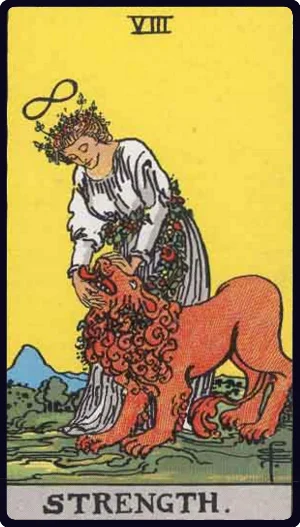
Like the figure in the card opening the lion's mouth with her bare hands, this card is about getting what you want not by overpowering but by handling things gently. It's not about enduring but about mastering, so the star of this period is the person who acknowledges the inner lion — anger, desire, fear — and then redirects it. The infinity sign above her head means this strength comes not from a single contest but from steadiness.
Reversed
These are the two ways of failing to handle the lion: trying to overpower it and hurting others or yourself, or, conversely, not trusting yourself and backing away from it. Holding everything in and then exploding all at once is also common, so the task in this period is not “enduring more” but “saying what you've been enduring.”
Strength — Daily Fortune
Upright
Core
It's a day when you get what you want without getting angry.
Detail
Situations that force won't fix come up — a difficult person, a child who won't listen, a slow customer — and the one who lowers their voice and says it once more wins. Morning patience comes back as afternoon results.
Advice
The moment irritation rises today, take three breaths and say the same thing more slowly. That difference in pace changes the outcome.
Caution
On days when you hold it together well, your body tires first. In the evening, make time when you don't have to master anything.
Reversed
Core
It's a day when what you've held in bursts out, or when you back down when you should push.
Detail
It takes the form of overreacting to a trivial remark, or, conversely, of swallowing what you wanted to say and regretting it once you get home. The cause isn't today's incident but what has built up over several days.
Advice
Avoid big conversations today; instead, write one line about “what I've been worn out by lately.” That's tomorrow's topic of conversation.
Caution
An angry message sent today comes back tenfold tomorrow. Just save it as a draft before you send it.
Strength — Love
Upright
Core
It's a time when gentleness moves the other person — they'll come without being pushed.
Detail
If you're in something unofficial, an unhurried attitude actually becomes part of your appeal; if you're dating, your ability to handle the other person's sensitive spots (family, past, pride) without poking at them builds trust. Long-standing conflicts may also quietly resolve.
Advice
When the other person is upset, don't ask “why” — say “I see, that must have been hard” first. In this period, the order of a conversation is everything.
Caution
Accepting everything is different from mastering. Set your boundaries in words — gently, but clearly.
Reversed
Core
You're suppressing emotions until they explode, or being pushed around by the other person.
Detail
It takes the form of piling up hurt feelings without saying anything and then exploding over something small, or, conversely, of losing your own needs while catering to the other person's moods. It's also a time when “untamed emotions” like jealousy and possessiveness shake the relationship.
Advice
Don't say everything that's built up all at once; say just the smallest thing this week. If the small thing gets through, the big things will too.
Caution
“I'll just put up with it” is the most dangerous phrase in this period. Enduring isn't a solution; it's a postponement.
Strength — Relationships
Upright
Core
It's a time when your ability to handle difficult people shines.
Detail
In front of a stubborn elder, a sensitive coworker, or a talkative friend, you have the power to guide things where you want without raising your voice. It's a time when, more than mediating conflicts, you build a reputation as “someone who's easy to be around.”
Advice
Start conversations with difficult people by summing up what they said in one sentence and reflecting it back. The lion opens its mouth when it feels understood.
Caution
Difficult people flock to those who handle them well. Decide how many people you can take on.
Reversed
Core
It's a time when your words come out too harsh, or, conversely, when you're so pressed down that you can't say what you want to say.
Detail
It takes the form of one remark ruining the mood at a family gathering, or of saying only “yes” to unfair demands at work and seething inside. Both are signs that you've misjudged the size of your own strength.
Advice
Practice saying “That won't work” once, briefly and in a low voice. Boundaries are made not by a loud voice but by a low one.
Caution
When someone who's been holding it in explodes, the people around them feel it came “out of nowhere.” Speak up in small ways before it bursts.
Strength — Marriage
Upright
Core
It's a time to handle difficult issues between you as a couple gently and get through them.
Detail
You work through issues that force won't fix — conflicts between the two families, money habits, parenting styles — with patience and tact. If marriage is ahead, it's a time when your ability to handle the tricky parts of your partner's family determines what life will be like after the wedding.
Advice
Pick the one topic you clash over most often with your spouse, and this month, talk about it with the goal of “not winning.” It may feel like losing, but the relationship gets better.
Caution
A spouse who handles things well ends up shouldering everything alone. Leave your partner a share to handle too.
Reversed
Core
What you've held in explodes into a marital fight, or one of you is living under the other's thumb.
Detail
It takes the form of a spouse who has held back for a long time exploding over something small, or of resentment building because your spouse doesn't take your side in front of the in-laws. If you're not yet married, it's a time when your partner's controlling tendencies start to show.
Advice
Say “this is what I've been holding back about lately” on a day when you're not angry. Words said on an angry day come across as emotion, not content.
Caution
A marriage where one person lives under pressure is quiet, so the problem doesn't show. Learn to tell quiet apart from peace.
Strength — Wealth
Upright
Core
It's a time when you have the strength to master impulses and protect your money.
Detail
You can stop in front of something you want to buy, and you can close out a losing investment without emotion. In negotiations, you tend to get the terms you want without coming on strong, which gives you the edge in conversations about salary, rates, or refunds.
Advice
Before a big purchase, wait a day, and if you still want it the next day, buy it. In this period, one day filters out most impulses.
Caution
In a period when you're good at holding back, you may cut even the “money you spend on yourself.” Money for health, learning, and rest isn't something to economize on.
Reversed
Core
Your self-control with money breaks down, or fear of losses keeps you from moving.
Detail
It takes the form of held-back spending bursting out all at once (revenge spending), or, conversely, of being unable to make necessary decisions (switching, closing out, investing) for fear of losing. Getting angry at people close to you over money comes from the same root.
Advice
Mark any “money I spent because I was upset” in this month's spending. That money is the lion you need to tame.
Caution
Holding on because you can't admit a loss isn't self-control; it's fear. Look at the numbers.
Strength — Career
Upright
Core
It's a time when you work through difficult people and situations without straining.
Detail
With demanding clients, resistant team members, or negotiations where you're being pushed back, you shift the flow without raising your voice. If you're a leader, “persuasion” works better than “orders” right now, and if you're an employee, your ability to gently rework a boss's unreasonable demands gets recognized.
Advice
Set up a meeting this week with the hardest person you deal with, but instead of trying to win, lay out their needs for them first. Whoever lays things out sets the next terms.
Caution
People who handle things well keep problems to themselves. Don't just “report” difficult issues to your boss; “share” them.
Reversed
Core
It's a time when you push the team through pressure, or, conversely, back down without confidence and miss opportunities.
Detail
It takes the form of instructions turning into commands so that the team goes quiet, or of hesitating with “can I really pull this off?” in presentations, proposals, or negotiations until the chance passes to someone else. It's also common to see pent-up frustration explode in a meeting.
Advice
If you're angry at your team, push the meeting back a day. If you lack confidence, cut your presentation down to one slide and practice just that one.
Caution
In an organization, “I've been putting up with this all along” sounds not like a reason but like an explosion. Speak up before it builds.
Frequently Asked Questions
Like the figure in the card opening the lion's mouth with her bare hands, this card is about getting what you want not by overpowering but by handling things gently. It's not about enduring but about mastering, so the star of this period is the person who acknowledges the inner lion — anger, desire, fear — and then redirects it. The infinity sign above her head means this strength comes not from a single contest but from steadiness.
These are the two ways of failing to handle the lion: trying to overpower it and hurting others or yourself, or, conversely, not trusting yourself and backing away from it. Holding everything in and then exploding all at once is also common, so the task in this period is not “enduring more” but “saying what you've been enduring.”
Will this card show up for you today?
Draw one free tarot card every day.
Related Cards
Save or share this card