Skip to main content
This site uses cookies for ad optimization and service analytics. Privacy Policy
Wheel of Fortune
Major Arcana
Upright keywords:
Change
Cycles
Destiny
Reversed keywords:
Bad luck
Resistance to change
Loss of control
Meaning of Wheel of Fortune
Upright
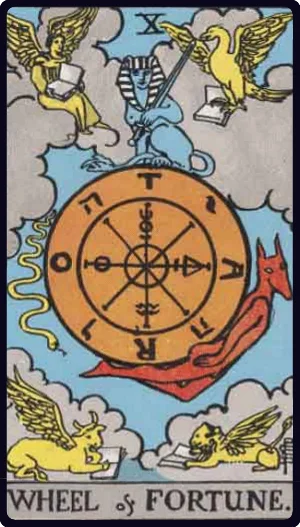
Just as the sphinx, the serpent, and Anubis rise and fall on the turning wheel, this card is about circumstances changing outside your control. It's a time when the tide shifts regardless of effort, so much of what goes well or badly isn't “your doing,” and skill in this period isn't turning the wheel but climbing on when it comes up. The four creatures on the clouds mean that even this flow has a direction.
Reversed
You're clinging on through the stretch where the wheel is going down, or going around and around in the same place. It shows up in two ways: resisting the flow because you can't let go of what you should (a relationship that's over, work that isn't working, old ways), or repeating the same mistake under a different name. Often the problem isn't bad luck but failing to learn from the wheel.
Wheel of Fortune — Daily Fortune
Upright
Core
It's a day when something unplanned changes the day — usually for the better.
Detail
A sudden call, something else filling the slot of a canceled plan, a person you run into by chance — these are today's material. Even if your morning plans get turned upside down in the afternoon, the results tend not to be bad, so the answer is to go with it rather than hold on.
Advice
To any unexpected offer that comes in today, try answering “Sure, sounds good” for now. It's not too late to decline tomorrow.
Caution
A big gamble doesn't suit a day when things are flowing well. Today's luck is an opportunity, not a guarantee.
Reversed
Core
It's a day when yesterday's problem comes back under a different name.
Detail
Things that make you say “again?” keep repeating — being late, losing things, the same argument with the same person. It's not bad luck; unchanged habits are bringing about the same results.
Advice
Pick one thing that repeated today and write one line: “Next time, I'll do this.” That one line stops the wheel.
Caution
If you write the day off with “I'm just unlucky today,” tomorrow will be the same day.
Wheel of Fortune — Love
Upright
Core
It's a time when chance opens up relationships — new meetings and reunions alike.
Detail
A connection comes from an unplanned setting rather than from introductions or apps, and you may reconnect by chance with someone you'd lost touch with. If you're dating, it's a time when the stage of your relationship naturally shifts because of outside circumstances (moving, a job change, family).
Advice
This month, go to one place you don't usually go. This card's connections are never in the places you always go.
Caution
Relying on chance makes you stop making an effort. Luck gives you the meeting, but staying in touch builds the relationship.
Reversed
Core
The pattern of ending things the same way with the same type of person keeps repeating.
Detail
It takes the form of starting with “this time will be different” and breaking up for the same reason, or of being unable to let go of a relationship that's over, leaving no room for a new connection. If you're dating, past arguments replay with the same lines.
Advice
Write one line each on why your last three relationships ended, and look for words that overlap. Those words are what you need to change.
Caution
“If it's meant to be, we'll meet again” can easily become an excuse for holding on in this period.
Wheel of Fortune — Relationships
Upright
Core
It's a time when the currents between people shift, new people come in, and old ones return.
Detail
A job change, a move, or a change in your circles reshuffles your social landscape, and a friend you haven't seen in a long time unexpectedly gets in touch. The people around you now may be different a few months from now, so it's best to stay open.
Advice
Don't put off an unexpected message — meet within that same week. For reunions in this period, timing is everything.
Caution
When the tide shifts, some people drift away too. Don't read it as betrayal. The board has simply changed.
Reversed
Core
It's a time when the same conflict with the same person keeps repeating, or when you can't let go of a relationship that's gone.
Detail
It takes the form of always clashing with family or coworkers at the same point, or of holding on to a friend who has drifted away so that your heart doesn't go into new relationships. When blaming others (“they're always like that”) becomes a habit, that's the sign.
Advice
In a recurring conflict, find one “thing I always say” and don't say it this time. You're not changing the other person; you're changing the script.
Caution
Even if “people don't change” is true, not changing yourself in front of that person is a choice.
Wheel of Fortune — Marriage
Upright
Core
It's a time when a big marriage-related turning point comes sooner than expected, and by a different route.
Detail
The flow here is an unexpected encounter leading to marriage, or a postponed wedding suddenly getting set because of outside circumstances (housing, work, a family member's health). If you're married, a big wheel turns that you as a couple have to ride together, like a move, a move abroad, or a financial change.
Advice
When a big change like marriage, a move, or a job change comes, talk about it as “something the two of us ride together.” It's not one person's change; it's the couple's.
Caution
Going with the flow is different from not preparing. The more suddenly a wedding gets set, the more you should talk about money and housing first.
Reversed
Core
Marital conflict keeps recurring over the same subject, or you're resisting a turning point in the marriage.
Detail
It takes the form of issues with in-laws, money, or housework repeating with the same lines for years, or of putting off big decisions like divorce, separation, or remarriage out of fear. If you're not yet married, it's a time when you carry over, unchanged, the reasons a past marriage (or relationship) failed.
Advice
Write down your recurring marital fights in three columns: “topic, opening line, how it ends.” Changing the third column comes first.
Caution
“It'll just happen again anyway” isn't a prophecy; it's a decision. Whoever says it is the one turning the wheel.
Wheel of Fortune — Wealth
Upright
Core
It's a time when unexpected money comes in or the flow of your finances shifts.
Detail
Unplanned income arrives — a refund, a bonus, money you'd forgotten about, an unexpected offer — and deals that were long stuck suddenly come loose. But money in this period came by luck, so you shouldn't spend it on the assumption that there'll be “more next time.”
Advice
Lock away half of any unexpected money first. Money that comes by luck easily goes by luck.
Caution
Raising the stakes on investments while the tide is good isn't the bright side of this card. The wheel goes down, too.
Reversed
Core
The same money mistakes keep repeating, or you lose more because you can't let go of a loss.
Detail
It takes the form of overspending in the same place as last month, or of holding on to a losing investment until it “breaks even” and losing more. If “I was just unlucky this time” comes out for the third time, it's not luck; it's your approach.
Advice
Look through three months of spending for money that leaks out through the same item every month. Plugging just that one leak changes the flow.
Caution
Thinking about breaking even keeps you from cutting your losses. Money you've lost is already lost; only what's left is yours.
Wheel of Fortune — Career
Upright
Core
It's a time when opportunities open up as the market or the organization reshuffles.
Detail
Changes that have nothing to do with your effort — a reorganization, a change in who's in charge, a competitor pulling out, a policy shift — create openings. New projects get assigned suddenly or delayed approvals come through, so those who were ready are the first to climb aboard.
Advice
When the board changes, be the first to say, “I'll do it.” In this period, positions are decided more by how fast you raise your hand than by skill.
Caution
If you mistake results that rode the tide for skill, you'll fall off on the wheel's next turn. Keep a record of what was luck.
Reversed
Core
It's a time when the same failure repeats project after project, or when you fall behind by resisting change.
Detail
It takes the form of every plan collapsing at the same stage (schedule, validation, staffing), or of being pushed back because you cling to old methods after the market has changed. When “it worked last time” comes up often in meetings, that's the sign.
Advice
Lay the post-mortems of three failed projects side by side and look for the causes they share. That's what to fix first in this plan.
Caution
“That's just how the industry is” is what people who miss change say. The wheel turns before the industry does.
Frequently Asked Questions
Just as the sphinx, the serpent, and Anubis rise and fall on the turning wheel, this card is about circumstances changing outside your control. It's a time when the tide shifts regardless of effort, so much of what goes well or badly isn't “your doing,” and skill in this period isn't turning the wheel but climbing on when it comes up. The four creatures on the clouds mean that even this flow has a direction.
You're clinging on through the stretch where the wheel is going down, or going around and around in the same place. It shows up in two ways: resisting the flow because you can't let go of what you should (a relationship that's over, work that isn't working, old ways), or repeating the same mistake under a different name. Often the problem isn't bad luck but failing to learn from the wheel.
Will this card show up for you today?
Draw one free tarot card every day.
Related Cards
Save or share this card