Skip to main content
This site uses cookies for ad optimization and service analytics. Privacy Policy
Justice
Major Arcana
Upright keywords:
Fairness
Truth
Balance
Reversed keywords:
Injustice
Dishonesty
Unaccountability
Meaning of Justice
Upright
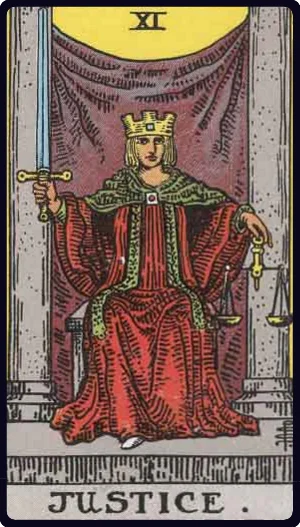
Like the figure holding scales in one hand and an upright sword in the other, this card judges by facts and balance, not by feelings. It's a season of cause and effect — you reap what you sow — so the results of past choices come back to you now, and formal decisions such as contracts, rulings, and evaluations are made. The seat between the two pillars means the one who judges must not take sides, not even their own.
Reversed
The scales have tipped to one side. Being treated unfairly or judging with bias, dodging responsibility for a wrong you know you did, or, on the flip side, being so strict with yourself alone that you punish yourself — these are the three faces of this period. Whichever it is, the answer is to go back to “putting all the facts on the table.”
Justice — Daily Fortune
Upright
Core
A day when something needs to be weighed fairly.
Detail
Settling accounts, dividing up roles, sorting out whose fault something is, and checking paperwork are today's themes. The person who lists facts rather than feelings gets results, and what you said and did last week comes back to you today as an evaluation.
Advice
For anything you have to decide today, write down “three facts” first and then judge. Look at your feelings after that.
Caution
A day of saying the right thing is also a day when relationships easily turn cold. After the point you're right about, add a single “but still.”
Reversed
Core
A day when something unfair happens to you, or when it's easy to pin your own mistake on someone else.
Detail
It shows up as taking on responsibility that isn't yours, or, conversely, passing off your own mistake as “just the circumstances.” It's also a day when small rule-breaking (traffic lights, deadlines, appointments) stands out more than usual.
Advice
If you've been wronged, start by keeping a record. If it's your fault, admit it before the day is over. Either way, tomorrow is too late.
Caution
On days when you think “I'm the only one losing out,” the math is often wrong. Count again.
Justice — Love
Upright
Core
A time to balance the relationship and make it official.
Detail
The ratio of give and take (messages, time, money) becomes a topic, and when it evens out, the relationship steadies. If you're still in the early stage where nothing has been named yet, it's a good time to clearly define what you are; if you're already together, it's when rightful apologies and closure for past issues take place.
Advice
When “I'm doing this much, and…” comes to mind, don't show your partner that tally — turn it into “I'd like you to do this.” Scales aren't for showing; they're for balancing.
Caution
Romance that keeps score of fairness becomes a ledger. Even if the numbers add up, without feeling it isn't a relationship.
Reversed
Core
A relationship where only one side gives, or a state where conflict lingers because a wrong goes unacknowledged.
Detail
It looks like messages, time, and money always coming from one side, or letting your partner's wrongs (lies, broken promises) slide with “well, it happens” until they pile up. Conversely, you may blame yourself so much for your own mistakes that you damage the relationship yourself.
Advice
Count who reached out first and who paid over the past month. If the numbers are lopsided, bring that up first.
Caution
“Because I love them more” isn't the reason for the imbalance — it's the result.
Justice — Relationships
Upright
Core
A time when you're given the role of judging and mediating.
Detail
In a quarrel between friends, a family money issue, or a question of accountability at work, you end up in the position of saying “that person is right.” Not taking sides builds trust, and that trust earns you the right to mediate the next conflict.
Advice
If you've taken on the role of mediator, hear each side separately and for the same amount of time. Order and length are the first proof of fairness.
Caution
The person who sorts out right from wrong draws resentment. After a judgment, you need words that reconnect people.
Reversed
Core
A time when you receive, or hand out, biased treatment.
Detail
At work, someone else takes the credit while only the blame comes to you, or within the family a pattern where one person always loses out comes to light. It can also show up the other way: you side with a particular person and leave someone else feeling wronged.
Advice
If you feel it's unfair, write it down as “date, task, outcome” instead of emotions and show it to the person involved. A record speaks louder than feelings.
Caution
If you tolerate bias with “that's just how they are,” you'll be next in line.
Justice — Marriage
Upright
Core
A time when the rules and roles of married life are set fairly.
Detail
It's a good time to clearly divide housework, money, and childcare, and matters involving law and paperwork — registering your marriage, a prenuptial agreement, sorting out assets — go smoothly. If marriage is ahead of you, “Can I make rules with this person?” becomes something to weigh.
Advice
Put housework and money into a chart and have each of you fill in your own column. Scales aren't measured in words; they're measured in charts.
Caution
A couple with perfect rules loses flexibility. Leave one “exceptions” column in the chart.
Reversed
Core
A state where roles and burdens between spouses have tipped to one side.
Detail
It looks like one person carrying all the housework, childcare, and support for both families, or, in money matters, one person hiding things while the other shoulders them. If you're not married yet, this is when your partner's “unfair habits” (broken promises, shifting blame) start to show.
Advice
For one week, have each of you write down the time you spend on housework and compare. Don't argue — just show the numbers.
Caution
If you cover unfairness with “because it's love,” it turns into a bill later. The ledger of a marriage always gets opened.
Justice — Wealth
Upright
Core
A time when contracts, settlements, and legal decisions are wrapped up fairly.
Detail
You get back money you were owed, correct an unfair charge, or get paperwork like taxes, insurance, and inheritance in order. Since the results of past spending and investing come back exactly as they were, it favors those who have been diligent.
Advice
Put any promise involving money in writing this week. Contracts written in this period are honored for a long time.
Caution
Fixating on “fair terms” can make you lose the deal altogether. Check that the scales are level, but weigh the other side's time too.
Reversed
Core
A state where you lose out in an unfair deal or settlement, or keep putting off responsibility for a money problem.
Detail
It looks like a settlement with a business partner or family member that's stacked against one side, or signing a contract without reading it and getting caught by a clause later. Conversely, you may blame debts or losses on “the circumstances” and delay dealing with them.
Advice
If you have an unfavorable contract, look first for a clause that allows “termination or amendment.” A clause gets your money back better than indignation does.
Caution
“But you said so back then” carries no weight where money is concerned. If it isn't on paper, the promise doesn't exist.
Justice — Career
Upright
Core
A time when evaluations, contracts, and decisions are based on facts and results.
Detail
In performance reviews, bids, contract negotiations, and sorting out accountability, the side with evidence wins. If you're a leader, it's fair distribution among team members that gets judged; if you're an employee, it's the achievements you've kept on record.
Advice
Before a review or negotiation, put your results into a three-column table: “numbers, dates, deliverables.” One table changes the terms more than any verbal argument.
Caution
The right decision isn't always welcome. After deciding, separately look after your relationship with the people it put at a disadvantage.
Reversed
Core
A time when unfair evaluations or shifted blame create conflict in the organization.
Detail
It looks like credit flowing upward and blame flowing downward, or an unfavorable clause in a contract surfacing midway through a project. Conversely, from your position as the one who judges, you may side with a particular person and lose the team's trust.
Advice
If an evaluation feels unjust, gather records (emails, deliverables, schedules) instead of emotions and put them on a single page. Objections only work when they're made in writing.
Caution
If you let unfairness slide with “that's just how this industry works,” the same clause will show up in your next contract.
Frequently Asked Questions
Like the figure holding scales in one hand and an upright sword in the other, this card judges by facts and balance, not by feelings. It's a season of cause and effect — you reap what you sow — so the results of past choices come back to you now, and formal decisions such as contracts, rulings, and evaluations are made. The seat between the two pillars means the one who judges must not take sides, not even their own.
The scales have tipped to one side. Being treated unfairly or judging with bias, dodging responsibility for a wrong you know you did, or, on the flip side, being so strict with yourself alone that you punish yourself — these are the three faces of this period. Whichever it is, the answer is to go back to “putting all the facts on the table.”
Will this card show up for you today?
Draw one free tarot card every day.
Related Cards
Save or share this card