Skip to main content
This site uses cookies for ad optimization and service analytics. Privacy Policy
The Tower
Major Arcana
Upright keywords:
Collapse
Sudden change
Revelation
Reversed keywords:
Averted disaster
Fear of change
Meaning of The Tower
Upright
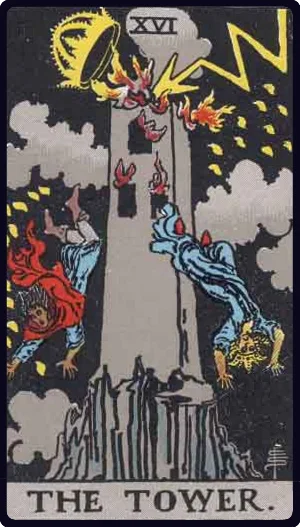
Like the image of lightning striking the crown and two people falling from the tower, this card is about a structure you believed in collapsing in an instant. Something — a relationship, a job, your health, or a belief — suddenly breaks, but what collapses is usually “something built wrong from the start,” so after the shock you can actually see the ground. The twenty-two flames mean the collapse is not an accident but something that built up over a long time.
Reversed
A state where what should fall is still standing. It has three faces: holding on and enduring while small cracks keep appearing; patching things up temporarily to delay the collapse and booking an even bigger shock; or, after the fall has already happened, being paralyzed by shock and unable to move. A delayed collapse isn't safety — it's interest.
The Tower — Daily Fortune
Upright
Core
A day when something unexpected turns the day upside down.
Detail
A sudden cancellation, breakdown, accident, or notice wrecks your morning plans, and the afternoon goes to damage control. You'll be startled, but what fell apart was usually already cracked, so by evening it tends to become “better that it blew up today.”
Advice
Don't try to fix what fell apart today; first write down “what the real problem was all along.” Damage control starts tomorrow.
Caution
Decisions made on a day of shock are made by the shock. Don't bring up resignations, breakups, or big purchases today.
Reversed
Core
A nerve-racking day when it feels like something is about to blow, but it doesn't.
Detail
You spend the day on stopgaps for a device about to break down, a boss about to explode, and a schedule about to collapse. Or it's a day when you haven't recovered from a past shock and can't bring yourself to start today's work.
Advice
Pick one thing you're holding together with a stopgap and set a date for “when I'll fix it properly.” If you don't, it will set the day it blows up.
Caution
“It's still okay” is the least trustworthy phrase in this card today.
The Tower — Love
Upright
Core
A time when something happens that brings down the very premise of the relationship.
Detail
A lie, another person, or a hidden fact comes out, or a sudden breakup notice arrives. If you're dating, an event shatters your belief that “this person is like this,” and while that can end the relationship, it can also let a real relationship begin for the first time.
Advice
If you've learned something shocking, don't decide that day. If you feel the same three days later, say it then.
Caution
Don't try to restore a collapsed relationship to “the way it was.” The way it was was built wrong.
Reversed
Core
A state of propping up a relationship that should fall, or of being unable to get out from under the shock of a past breakup.
Detail
It looks like patching up a relationship that keeps cracking with “just this once,” or being so shaken by a breakup that, far from starting a new relationship, even daily life is paralyzed. A romance that's always anxious even when nothing is happening is also a face of this period.
Advice
Write down “events that have happened three or more times in this relationship.” At three times, it's not a crack but a structure.
Caution
A relationship whose collapse is postponed falls harder by as much as it was postponed. Ending it now is the smallest shock.
The Tower — Relationships
Upright
Core
A time when the true nature of people or groups you trusted comes out and your relationships get reshaped.
Detail
A friend's betrayal, a group splitting apart, or a sudden eruption of conflict at work arrives. It's startling, but a relationship that collapses was usually one only one side believed in, so it's also a time when it becomes clear who remains.
Advice
If a relationship has collapsed, first count “who's still here.” Reaching out to those who remain is the first step of recovery.
Caution
If you talk about it everywhere while still in shock, the collapse of a relationship spreads into a collapse through rumors. Say nothing for three days.
Reversed
Core
A time when conflict festers without erupting, or when you can't rebuild after it has.
Detail
It looks like complaints within the family or group traveling only behind people's backs while things stay quiet up front, or, after a big fight, no one reaching out first so the relationship has stalled. “Afraid everything will fall apart if I say it” is the silence of this period.
Advice
If it's a festering problem, first send the person involved one line: “I think we need to talk about this.” It's not blowing it up — it's opening it.
Caution
A conflict that hasn't erupted hasn't gone away; it's growing.
The Tower — Marriage
Upright
Core
A time when an event arrives that shakes the foundation of the marriage.
Detail
Something you thought “surely not” — an affair, debt, health, a problem with the in-laws — becomes real, or an event big enough to call off the wedding erupts beforehand. The shock is great, but if the marriage was built wrong, now is the least painful time for it to fall; if it's a marriage that can hold, honest conversation begins for the first time after this event.
Advice
If something has blown up, don't decide now “whether to continue this marriage”; first gather all of “what is true.” The decision comes after all the facts are in.
Caution
If you tell both families and your friends everything in the moment of shock, it becomes a decision you can't undo. Keep it between the two of you for three days.
Reversed
Core
A state of temporarily holding up a marriage that feels about to collapse, or of living paralyzed after a major event.
Detail
It looks like patching up recurring problems “for the kids” while never knowing when things will blow, or, after an event like an affair or bankruptcy, being stuck — able neither to divorce nor to recover. If you're not married yet, a decision you postponed despite knowing about a major flaw is drawing near.
Advice
Write down one thing “I'm keeping from blowing up in this marriage,” and bring it up with your spouse within this month. Opening it brings down less than holding it back.
Caution
“Well, it hasn't fallen apart yet” is the most expensive reassurance in a marriage.
The Tower — Wealth
Upright
Core
A time of sudden loss or of an income source collapsing.
Detail
Unexpectedly large sums go out, or money that was coming in stops — a layoff, a business closing, an accident, an investment crash, a big repair bill. It's a shock, but what collapses is usually money concentrated in one place, so rebuilding starts with “spreading it out.”
Advice
Check whether your income currently comes from just one source. If so, this card's answer is to create a small second source of income before it collapses.
Caution
A “big decision to win it back” right after a loss creates a second collapse. Put nothing in for a month.
Reversed
Core
A state of temporarily holding off a financial collapse, or of having let go of money management after a big loss.
Detail
Juggling credit cards, paying off loans with loans, and hiding losses from your spouse are the makeshift walls of this period. Conversely, there's also the paralysis of having already suffered a big loss and no longer looking at your bank account because “what's the point.”
Advice
If you're juggling debts, honestly add up the total just once. Only those who've seen that number begin to rebuild.
Caution
“With the money coming in next month” is what a tower on the verge of collapse says.
The Tower — Career
Upright
Core
A time when the structure of an organization or business suddenly collapses or is overturned.
Detail
Events arrive that shatter “what you trusted” — key staff leaving, a major client leaving, regulations, accidents, system failures. Amid the shock, faulty structures (dependence on one person, dependence on one client, practices without review) come to light, and the organization that fixes them moves on to the next stage.
Advice
If something has blown up, write “what the real problem was all along” on one page and share it with the team. A leader who looks for the structure before looking for someone to blame protects the team.
Caution
If you go looking for who's to blame right after the shock, the team goes silent. Fix the structure, not the people.
Reversed
Core
A state of holding on by patching over a crisis, or of an organization paralyzed after a major failure.
Detail
It looks like running on quick fixes for deficits, departures, and outages without knowing when things will blow, or no one daring to propose a new plan after a big failure. The signal is “if we can just get through this quarter” repeating quarter after quarter.
Advice
List every item you're holding together with quick fixes, and this quarter “properly tear down” one of them and rebuild it. A small, controlled collapse prevents a big one.
Caution
Not tearing down what's going to fall isn't stability; it's delay. And delay accrues interest.
Frequently Asked Questions
Like the image of lightning striking the crown and two people falling from the tower, this card is about a structure you believed in collapsing in an instant. Something — a relationship, a job, your health, or a belief — suddenly breaks, but what collapses is usually “something built wrong from the start,” so after the shock you can actually see the ground. The twenty-two flames mean the collapse is not an accident but something that built up over a long time.
A state where what should fall is still standing. It has three faces: holding on and enduring while small cracks keep appearing; patching things up temporarily to delay the collapse and booking an even bigger shock; or, after the fall has already happened, being paralyzed by shock and unable to move. A delayed collapse isn't safety — it's interest.
Will this card show up for you today?
Draw one free tarot card every day.
Related Cards
Save or share this card