Skip to main content
This site uses cookies for ad optimization and service analytics. Privacy Policy
The Devil
Major Arcana
Upright keywords:
Desire
Bondage
Materialism
Reversed keywords:
Release
Breaking free
Awareness
Meaning of The Devil
Upright
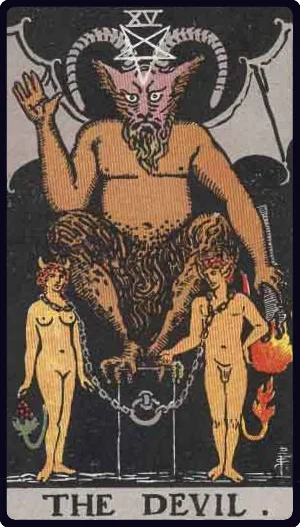
The core of this card is that the chains around the two figures' necks are loose enough to slip off, yet they don't. You're bound to something — money, people, habits, or pleasure — and you stay because it's enjoyable or comfortable, so the problem isn't temptation but failing to see that “I'm choosing this.” The inverted pentagram means your priorities have been turned upside down.
Reversed
The moment you notice the loose chains. It splits two ways: you begin breaking free from a relationship, addiction, debt, or obsession that bound you, or, conversely, you sink deeper with “this much is fine.” Which way it's going is told by whether you “cut it back or increased it” this month.
The Devil — Daily Fortune
Upright
Core
A day full of things you do “even though you know better.”
Detail
The scenes follow one after another: staring at a screen late into the night, buying things you don't need, going back to what you decided to quit, replying to someone you decided not to see. Today's temptations aren't strong. You simply don't say no.
Advice
Keep just one of the things you'd “decided not to do” today. It's fine to lose on the rest. A day on which you held one line is different.
Caution
“Just today” is this card's spell. If you've said it once, you're already on the second time.
Reversed
Core
A day to take one step out of what's been binding you — small, but real.
Detail
Canceling a subscription, leaving the group chat of a bad relationship, and letting one habit pass today without giving in are today's themes. Conversely, it could be a day of sinking deeper with “this much is fine,” so check in the evening which way it went.
Advice
If you held back even once today, write it down. At the same moment tomorrow, that record will give you strength.
Caution
If you let your guard down with “I'm free now” on the day you break away, the chains will close again. Today is the first day, not the last.
The Devil — Love
Upright
Core
A time of strong attraction — but that attraction is binding the relationship.
Detail
Physical attraction, possessiveness, and jealousy come before love, or a relationship with someone you know is bad for you but can't cut off carries on. If you're dating, an obsession with checking up on each other (location, messages, passwords) moves to the center of the relationship.
Advice
Write down “what's good” about this relationship and “why I can't leave” as two separate lists. If the two lists differ, that's the chain.
Caution
“I can't live without this person” is often the language not of love but of chains.
Reversed
Core
A crossroads of breaking free from a binding relationship, or, conversely, falling in deeper.
Detail
There's a current of ending a bad relationship and finally breathing, or letting go of obsession so the relationship becomes healthier. On the other side is the picture of going back with “just one last time,” and how often you're in contact this month tells you which way it's going.
Advice
If there's someone you want to go back to, write in one line “what would be different if I went back.” If you can't write it, you have your answer.
Caution
Right after you break free is the most dangerous moment. Loneliness goes looking for the chains again.
The Devil — Relationships
Upright
Core
A time when relationships bound by self-interest, dependence, or social pressure come to light.
Detail
A group you dislike but can't leave, people who only call when they need something, and ties tangled up in money or favors sit at the center of your relationships. At work, you see that relationships with bosses and coworkers are kept up not “because you like them” but “because you need them.”
Advice
Among the people you met this month, mark those you met “because not meeting them would cost you.” Those marks are a map of your chains.
Caution
If you call a relationship bound by self-interest a friendship, you'll feel betrayed when the self-interest runs out. Name it accurately.
Reversed
Core
A time of breaking free from a toxic relationship, or of tightening its chains even further.
Detail
There's a current of putting distance between yourself and people who tear you down, and of leaving groups where you were always walking on eggshells. Conversely, you might accommodate someone even more with “but I still need them,” so either way, it's time to look honestly at “what I get” from that relationship.
Advice
This month, skip seeing one person who always leaves you feeling worse. Seeing what collapses gives you the answer.
Caution
The line used to hold back someone breaking free is “you've changed.” If you hear it, you're on the right track.
The Devil — Marriage
Upright
Core
A time when a marriage is bound more by conditions, money, or dependence than by love.
Detail
If marriage is ahead, it becomes clear whether your partner's conditions (home, job, family background) have come before your heart; if you're married, it becomes clear how large the parts held together “because we can't split up” (money, children, appearances) really are. Obsession, control, and secrets between spouses are also themes of this period.
Advice
Honestly write down one thing “I'm bound to in this marriage.” That isn't what's bad — not knowing it is.
Caution
“I can't get out anyway” is the phrase that turns a marriage into chains. Don't forget that you are choosing.
Reversed
Core
A crossroads where you begin to break free from what bound the marriage (debt, obsession, control, addiction), or where it deepens.
Detail
There's a current of the couple clearing debt together, or of one side's control and suspicion easing so the relationship can breathe. Conversely, you might treat the problem as normal with “we've always been like this” and go even deeper. If you're not married yet, this is when you first see signs of your partner's obsession or addiction.
Advice
Choose one problem that has bound your marriage, set it together as a “cut-back goal,” and put a number on it. For debt, an amount; for suspicion, a count.
Caution
If only one of you tries to break free, the other pulls on the chain. Break free together — and if that isn't possible, that too is an answer.
The Devil — Wealth
Upright
Core
A time when money is running you — through debt, impulse, or greed.
Detail
Card bills that grow back no matter how much you pay, investments you keep feeding even as you lose, and the habit of buying things you don't need are this card's money reading. Big money may come in, but it goes in a direction that binds you even more (bigger debt, bigger bets).
Advice
Write down every “regretted purchase” this month and add them up. That number is the weight of your chains. Seeing it is the first key.
Caution
“This time is different” is the most dangerous phrase where money is concerned. If it's your third time in the same spot, it isn't different.
Reversed
Core
A state of beginning to break free from debt, addiction, or impulse spending, or of rationalizing it and sinking deeper.
Detail
There's a current of making a plan to pay off debt and cutting out spending, and on the other side the picture of justifying spending with “it's because of stress.” The balance on your debt this month tells you which way it's going.
Advice
Pick your oldest debt, decide how much you'll pay on it this month, and set up an automatic transfer. You break free through structure, not willpower.
Caution
The most common relapse is someone who's started paying off debt deciding “this is enough” and spending again.
The Devil — Career
Upright
Core
A time when being bound to profit shakes your principles, or when you're dragged around by contracts and clients.
Detail
It looks like revenue so tied to one big client that you can't say “no,” or shortcuts, exaggeration, and unreasonable terms becoming normal. Big ambition produces results, but those results take your team, your health, and your reputation as collateral.
Advice
If more than half your revenue comes from one client, that's the chain. Make “a second client” your goal for next quarter.
Caution
“That's just how things are done in this industry” is the phrase that turns shortcuts into the norm. When you hear it, reread the contract.
Reversed
Core
A crossroads of breaking free from deals, practices, or roles that have been dragging you around, or of getting more entangled.
Detail
There's a current of cutting ties with an unreasonable client and regaining normal terms, and also the picture of accepting even worse terms with “cutting it off now would cost us.” Identifying so closely with your company that you can't leave is the same chain.
Advice
Write down: “If this deal were offered to me for the first time today, would I take it?” If not, making a plan to wind it down is this period's task.
Caution
Don't make the decision to break free all at once — build an alternative first. Before you cut the chain, you need somewhere to stand.
Frequently Asked Questions
The core of this card is that the chains around the two figures' necks are loose enough to slip off, yet they don't. You're bound to something — money, people, habits, or pleasure — and you stay because it's enjoyable or comfortable, so the problem isn't temptation but failing to see that “I'm choosing this.” The inverted pentagram means your priorities have been turned upside down.
The moment you notice the loose chains. It splits two ways: you begin breaking free from a relationship, addiction, debt, or obsession that bound you, or, conversely, you sink deeper with “this much is fine.” Which way it's going is told by whether you “cut it back or increased it” this month.
Will this card show up for you today?
Draw one free tarot card every day.
Related Cards
Save or share this card