Skip to main content
This site uses cookies for ad optimization and service analytics. Privacy Policy
7 of Pentacles
Minor Arcana
Upright keywords:
Patience
Long-term investment
Assessment
Reversed keywords:
Impatience
Poor returns
Meaning of 7 of Pentacles
Upright
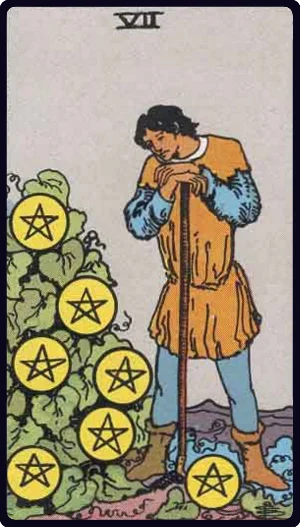
A picture of a farmer leaning on his hoe, gazing at the gold coins growing on a vine. What was planted is still growing, so this is not the time to harvest; it's a card of stopping to ask “Am I on the right track?” and waiting. Pick too early and it's unripe; leave it unwatched and you'll miss it, so evaluation and patience are needed together.
Reversed
Waiting has gone wrong. It takes three forms: picking what's unripe out of impatience, feeling your effort was wasted because the harvest doesn't match it, or digging the same field without checking and failing to change direction. Often it's not that there are no results, but that the ruler you measure them with, or the timing, is wrong.
7 of Pentacles — Daily Fortune
Upright
Core
A day to check your progress instead of rushing for results.
Detail
An unanswered proposal, results not yet in, and work half done are today's material. Rather than hurrying in the morning, taking stock of “how far have I come?” once in the afternoon will show you what to do next week.
Advice
Pick one task in progress and write two lines: what you've done so far and what's left. That's enough for today.
Caution
Nudging someone with “why isn't this done yet?” won't bring the answer any sooner today.
Reversed
Core
A day when you easily grow impatient because your effort doesn't show.
Detail
Something you've been working at for days feels stuck in place, and other people's results catch your eye and make you hurry. In the afternoon, two paths split: forcing out something unfinished, or giving up with “what's the point?”
Advice
Don't try to produce results today; just change one thing about how you're working on a task in progress. Even changing where you sit counts.
Caution
Don't decide “it was all for nothing” in the evening. In the morning, you'll see what has grown.
7 of Pentacles — Love
Upright
Core
A time when the relationship is growing, so you watch and wait.
Detail
If you're in the early stages, give them time to make up their mind; if you're in a relationship, rather than rushing the next step (making it official, moving in, marriage), it's a good time for the two of you to look back on how far you've come. The fruit is forming, but it isn't ripe yet.
Advice
Ask once, without pressure, “How far have we come?” More than the answer, counting it up together is the conversation of this time.
Caution
Waiting and neglecting are different. Keep up the messages and dates while you wait.
Reversed
Core
You feel you're not getting back what you put into the relationship, or you're pushing for an answer before it's ripe.
Detail
“I've done so much” often comes to mind; you demand a firm answer and they back away, or, the other way, you let the relationship go because your effort seems wasted. The problem is often not the other person but the ruler you're measuring with.
Advice
Write down, month by month, what you've received in this relationship. If there's nothing, let go; if there's something, stop pushing.
Caution
“Answer me now” is picking unripe fruit. Once picked, it won't grow back.
7 of Pentacles — Relationships
Upright
Core
A time when relationships you've built slowly settle into place.
Detail
A group you've invested in for years, someone you've kept in steady touch with, a junior you've spent time on: these relationships quietly grow solid. Rather than adding new people, it's a good time to look back on how far your current relationships have come.
Advice
Among people you've known for a long time, count those who would come if you were struggling. That list is the current state of your field.
Caution
Relationships cool when you calculate them. Count if you like, but don't tell them the number.
Reversed
Core
A time when relationships you invested in don't seem to give back, or you expect too much from people too soon.
Detail
Someone you looked after is indifferent when it's your turn, or you want to get close to someone new quickly and they feel pressured. If “after all I've done for them” is attached to every relationship, this is that time.
Advice
Leave one relationship that doesn't give back alone, and see one new person for three months without expectations.
Caution
What you invest in people bears fruit somewhere else. If you try to collect from the people you gave to, you'll usually be disappointed.
7 of Pentacles — Marriage
Upright
Core
A time when your marriage or wedding preparations are in the “building” stage.
Detail
The two of you are growing long-term goals together, like a home, children, or savings, and now is the time to check progress rather than results. If a wedding is ahead, taking time to get to know each other more instead of rushing will shape life after the wedding.
Advice
Pick one of your big shared goals and write down together what percentage of the way there you are. A number eases impatience.
Caution
Couples who look only at the goal don't see each other as they are now. On review days, share a meal too.
Reversed
Core
The effort you've put into your marriage feels wasted, or rushing toward marriage throws preparations off track.
Detail
However hard you work on housework, money, or parenting, your spouse doesn't seem to notice, or you press for a wedding date and your partner backs away. Letting wedding preparations become the goal and forgetting why you're getting married is also a sign of this time.
Advice
Each of you write down “what I planted in this marriage and what has grown.” If the “grown” column is empty, change your approach; if it's full, change your expectations.
Caution
In a marriage, “after everything I've done” becomes an invoice. Do the math on your own, and put it to your spouse as a request.
7 of Pentacles — Wealth
Upright
Core
A time when long-term investments and savings are growing — not yet time to harvest.
Detail
Money that takes time, like regular savings, pensions, real estate, or business investments, is quietly growing, and what you need to do now is check returns and rebalance, not withdraw. It's not a good time for money chasing short-term gains.
Advice
Make a rule to check the returns on long-term money only once a quarter. Check it daily, and you'll end up picking it unripe.
Caution
Pulling out midway with “this is good enough” wastes all the time so far. Leave it until the end of the planned period.
Reversed
Core
Money isn't coming back in proportion to what you put in, or you keep impatiently pulling it out and putting it back.
Detail
Losses come from pouring money into something that yields no return, or from the impatience of selling when it rises a little and buying when it dips a little. It's digging a field that's pointed the wrong way, adding effort without checking.
Advice
If you have money that has earned nothing for over a year, write one line deciding whether the method is wrong or the time isn't up yet. If you can't, ask a professional once.
Caution
Money you move in and out because “I think it'll go up this time” isn't in a field; it's in a casino.
7 of Pentacles — Career
Upright
Core
A stage for a midpoint review rather than rushing for results.
Detail
A product awaiting a response after launch, a new venture still growing, a long-term project whose results aren't visible yet: these are this card's stage. If you're a leader, you need a retrospective to decide “continue, adjust, or stop”; if you're an employee, it's a time when consistency leads to recognition.
Advice
Lay out your current project in three columns: “what it has taken so far, what's visible now, what's needed from here.” That table is next quarter's decision.
Caution
If the review drags on, the review becomes the work. Hold one retrospective, and decide on the spot.
Reversed
Core
A stage when the team is worn out by effort without results, or changes direction impatiently.
Detail
You keep adding people to a project that isn't producing, or, the other way, you repeatedly shut things down before results come in and start something new. If “but we worked so hard” is the conclusion of a meeting, you're measuring with the wrong metric.
Advice
For each project, set one “number that would let us call it a success.” Without that number, you can judge neither effort nor waste.
Caution
A project pulled up before it ripens gets recorded as a failure, but it didn't fail. Next time, set the timeline first.
Frequently Asked Questions
A picture of a farmer leaning on his hoe, gazing at the gold coins growing on a vine. What was planted is still growing, so this is not the time to harvest; it's a card of stopping to ask “Am I on the right track?” and waiting. Pick too early and it's unripe; leave it unwatched and you'll miss it, so evaluation and patience are needed together.
Waiting has gone wrong. It takes three forms: picking what's unripe out of impatience, feeling your effort was wasted because the harvest doesn't match it, or digging the same field without checking and failing to change direction. Often it's not that there are no results, but that the ruler you measure them with, or the timing, is wrong.
Will this card show up for you today?
Draw one free tarot card every day.
Related Cards
Save or share this card