Skip to main content
This site uses cookies for ad optimization and service analytics. Privacy Policy
5 of Swords
Minor Arcana
Upright keywords:
Conflict
Tension
Hollow victory
Reversed keywords:
Reconciliation
Letting go
Meaning of 5 of Swords
Upright
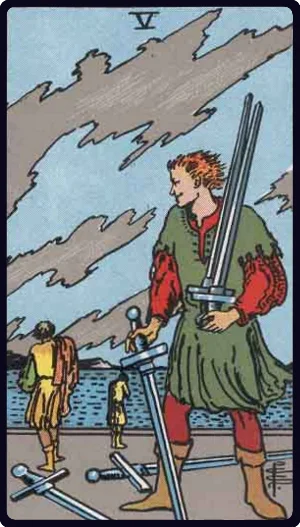
One figure gathers up the swords with a smirk while two others walk away, heads bowed. It speaks of a victory where you win the fight but lose the people, a quarrel in which winning itself has become the goal. The card tells you to look not at who is right but at what this fight costs you.
Reversed
The quarrel ends and reconciliation or closure begins. You may revive a relationship by stepping back first or apologizing, or pull out of a fight you can't win. On the other hand, a fight that ended only on the surface may leave resentment that flares up again.
5 of Swords — Daily Fortune
Upright
Core
A day when the urge to win an argument grows strong.
Detail
Small differences of opinion easily escalate into battles of pride, and even if you beat the other person with logic, you don't come away feeling any better. An argument you win today is likely to come back tomorrow as awkwardness in the air.
Advice
At the moment you want to push back, try saying first, “I can see how you'd look at it that way.”
Caution
If you publicly rebut someone in a group chat, you lose more than you gain, even if you win.
Reversed
Core
A day when a chance comes to clear away the residue of a past quarrel.
Detail
You may run into someone things have been awkward with for days, or they reach out first. On the other hand, an argument you thought was over may flare up again over something small, so the words you open with today set the direction.
Advice
Send a short greeting with no agenda to someone things have been awkward with.
Caution
If you start rehashing who was right and wrong in the name of making up, it becomes a second fight.
5 of Swords — Love
Upright
Core
A time when your hearts drift apart while you argue over who's right.
Detail
Every time you fight, you try to win with words or drag up past mistakes to gain the upper hand. In a budding romance, too much push and pull wears the other person out until they leave; in a relationship, fights repeat in which both the winner and the loser end up lonely.
Advice
In your next argument, instead of a conclusion, say just one thing, “what hurt me,” and stop there.
Caution
A victory won by attacking a weak spot that pains your partner hastens the end of the relationship.
Reversed
Core
A romance where the door to reconciliation opens after a fight.
Detail
One of you apologizes first, or you both set down the need to win. On the other hand, a fight passed over without talking may pile up inside, and you may clash again over something similar.
Advice
Before weighing who was at fault, acknowledge your own part first, as in “I went too far back then.”
Caution
If you keep going back over the past after receiving an apology, your partner will close their heart again.
5 of Swords — Relationships
Upright
Core
A time when disputes arise in which even winning leaves you with nothing.
Detail
A group splits into sides, you compete with a coworker for credit, or a battle of pride breaks out between friends. When one side wins, the other quietly drifts away, and people slip away from around the winner.
Advice
Write in one line what you'd gain by winning this fight. If there's nothing to write, it's a fight to step back from.
Caution
If you drag others in to win, the fight grows and trust shrinks.
Reversed
Core
A time when a chance comes to either close out or revive a strained relationship.
Detail
You join hands again with someone you'd fought with in the face of a shared problem, or quietly withdraw from a conflict you can't win. But if you reconcile only in words while harboring resentment inside, the relationship stays where it was.
Advice
Separate the relationships you want to revive from those to close out, and reach out first only to the ones worth reviving.
Caution
Trying to resolve every conflict will wear you out. Some relationships are fine to let go.
5 of Swords — Marriage
Upright
Core
A time when disagreements between spouses turn into a matter of winning and losing.
Detail
When you argue over chores, money, or either family, who's right becomes more important than solving the problem. If you're about to marry, power struggles may break out over every decision in the preparations, wearing you both out.
Advice
When an argument starts, first ask each other, “What's the problem we actually want to solve?”
Caution
If you bring in family or friends' opinions to win the fight, your spouse feels alone.
Reversed
Core
A time when reconciliation begins after a marital fight, or resentment lingers.
Detail
There's a movement where you each take a step back and start talking again, and there's also a version where a fight that fizzled out without an apology lingers as a chill in the air. Which one it is depends on who speaks first.
Advice
After a fight, rather than pressing for a conclusion, bring the temperature back first by sharing a dinner together.
Caution
A fight ended with “Fine, let's just drop it” isn't over; it's only postponed.
5 of Swords — Wealth
Upright
Core
A time when even winning a dispute over money leaves you at a loss.
Detail
You end up arguing over shares, as with settling accounts, dividends, or money matters between family members. Even if you fight to the end and squeeze out a little more, if you lose the relationship and your time, the math comes out negative.
Advice
Before you argue, decide first, “What am I willing to lose for this amount?”
Caution
Deciding on legal action or a public exposé while your feelings are hurt makes the cost even greater.
Reversed
Core
A time when disputes over money get settled.
Detail
A long-drawn-out settlement ends in agreement, or you decide to accept the loss and walk away. Even if one side yields to preserve the relationship, it's best to put the terms in writing.
Advice
Put what you agreed on in writing, even briefly, and confirm it with each other.
Caution
If you pour out your sense of unfairness to others after the agreement, the settled dispute starts again.
5 of Swords — Career
Upright
Core
A stage when competition over results overheats.
Detail
Who takes the credit and whose plan gets adopted become more important than the work itself, and resentful colleagues are left behind the winner. If it's a fight with competitors, it may be the kind, like a price war, where even winning leaves no profit.
Advice
Write down what the team would be left with if you win this competition, and what it would be left with if you lose.
Caution
If you publicly belittle a colleague in a meeting, no one will help you in the next collaboration.
Reversed
Core
A stage when overheated competition cools down and relationships are rebuilt.
Detail
You realign terms with a department or partner you'd been clashing with, or strategically withdraw from a competition you can't win. If resentment from past conflicts remains, misunderstandings easily arise early in a new collaboration.
Advice
Summarize the cause of past conflicts in terms of structure, not people, and share it.
Caution
If you interpret stepping back as defeat and look for a chance to retaliate, the same fight will come again.
Frequently Asked Questions
One figure gathers up the swords with a smirk while two others walk away, heads bowed. It speaks of a victory where you win the fight but lose the people, a quarrel in which winning itself has become the goal. The card tells you to look not at who is right but at what this fight costs you.
The quarrel ends and reconciliation or closure begins. You may revive a relationship by stepping back first or apologizing, or pull out of a fight you can't win. On the other hand, a fight that ended only on the surface may leave resentment that flares up again.
Will this card show up for you today?
Draw one free tarot card every day.
Related Cards
Save or share this card