Skip to main content
This site uses cookies for ad optimization and service analytics. Privacy Policy
King of Cups
Minor Arcana
Upright keywords:
Emotional balance
Calm
Diplomacy
Reversed keywords:
Volatility
Repressed emotion
Meaning of King of Cups
Upright
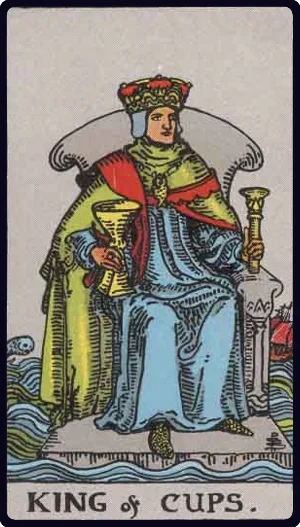
A king sits on a throne upon the sea, holding a cup, yet the water never touches him. This isn't an absence of emotion but a maturity that has lived through every feeling and remains steady; it's the card of someone who reads others' hearts and receives them generously. It's a time when a counselor, an elder, or an advisor appears, or when you step into that role yourself.
Reversed
The power to handle emotions has gone off course. It shows up three ways: using the ability to read others' hearts to manipulate them, pressing feelings down behind a calm surface until they burst one day, or wavering in dependence on alcohol, relationships, or comfort. It's also a time when generosity reads as indecision, and composure as coldness.
King of Cups — Daily Fortune
Upright
Core
A day to listen to others without being swept up in emotion.
Detail
A coworker's complaints, a family member's worries, and a friend's troubles come to you today. Simply listening to the end without offering answers is enough to ease them, and your own mood grows calmer in the afternoon than in the morning.
Advice
If someone opens up today, answer three times with “I see” instead of giving advice. That's your role today.
Caution
It's a day when taking in others' feelings makes you forget your own. In the evening, give yourself time when you listen to no one.
Reversed
Core
A day when you act calm but are shaken inside.
Detail
You say you're fine and then get irritated once you turn away, swallow your words to match someone's mood, or well up over something trivial in the afternoon. What you've been holding down is close to the surface today.
Advice
Name one feeling you had today and write it down. A single word like “hurt” or “tired” is enough.
Caution
If you handle your feelings with drinks or late-night talks, tomorrow morning will feel heavier. Going to bed early is the answer today.
King of Cups — Love
Upright
Core
A time when a mature person enters your love life, or when you take on that role yourself.
Detail
This is a meeting with someone who reads and accepts your moods; if you're in a relationship, being the one who calms down first and opens the conversation during a fight deepens things. Someone older or more experienced, someone of few words who gives a sense of stability, is this card's partner.
Advice
When your partner is angry, don't argue about the reasons; first say, “You're having a hard time right now.” This card's love begins with that one line.
Caution
Someone who accepts everything misses the moment to voice their own hurt. Bring out your own feelings at least once a month.
Reversed
Core
A state of using emotions as a weapon, or closing yourself off so your partner can't get close.
Detail
You know your partner's weak spots and use them to control the relationship, seem affectionate on the outside but never show your real heart, or wear your partner out with mood swings. If your partner says, “I can't tell what you're feeling,” this is that time.
Advice
Try once saying something vulnerable to your partner, like “Honestly, I was scared of this.” Manipulation starts with hiding weakness.
Caution
Controlling someone on the grounds that you understand their feelings isn't care. Ask whether they seem at ease.
King of Cups — Relationships
Upright
Core
A time when you're given the role of the elder or the counselor among people.
Detail
Two people in conflict come to you, a junior opens up about their worries, and difficult family matters gather around you. Acknowledging each person's feelings without taking sides builds trust, and that trust lasts.
Advice
When hearing both sides, ask “What's hard for each of you?” instead of “Who's right?” That question, more than any answer, untangles the relationship.
Caution
When you become everyone's counselor, there's no one left to hear your own story. Keep an elder for yourself too.
Reversed
Core
A time when using emotions or hiding your heart leaves relationships hollow.
Detail
You read people's hearts and steer them to your advantage, seem gentle on the surface but say something else behind their backs, or listen to people's troubles and later use them. On the other hand, you may suppress your own feelings so much that people around you feel “that person is like a wall.”
Advice
Look back on whether, in the past month, you've passed along something someone confided in you. If so, stop that first.
Caution
Moving people with kind words works in the short run, but in the long run no one stays.
King of Cups — Marriage
Upright
Core
A time when emotional maturity steadies the marriage.
Detail
The one who accepts a spouse's shifting moods and grows calm first in the face of big problems becomes the center of the couple. If you're about to marry, whether you can embrace your partner's emotional side like an adult is something to weigh, and mediating between the two families is also this card's kind of marriage.
Advice
On a hard day for your spouse, say “I'm right here with you” before offering solutions. A marriage's stability is built on days like that.
Caution
A spouse who always accepts loses a place to voice their own struggles. Regularly listen to the one who does the accepting.
Reversed
Core
A state where emotional manipulation, coldness, or dependence has settled between the couple.
Detail
One of you moves the other with guilt, emotions are shut down until conversation is a mere formality, or one partner leans on alcohol or relationships outside. If you're not yet married, it's a time when you sense your partner is hiding their heart behind affection.
Advice
Each of you write down one “feeling I haven't told my partner lately,” then swap and read. The rule is not to argue after reading.
Caution
A marriage that looks peaceful on the surface is the last to reveal its problems. Don't mistake quiet for stability.
King of Cups — Wealth
Upright
Core
A time to handle money without being swayed by emotion.
Detail
You stick to your plan when the market swings, stay calm in the face of losses, and don't get carried away by large sums. You may also find yourself hearing out others' money worries, as in financial counseling or advising, and long-held stable assets suit you well.
Advice
Starting this month, make it a rule to sleep on any money decision overnight. Composure comes not from personality but from rules.
Caution
With money, generosity leaks out as co-signing, lending, and lavish gifts. Don't open your heart and your wallet at the same time.
Reversed
Core
A state where emotions move your money: comfort spending, emotional investing, and dependence.
Detail
The pattern repeats of spending when you feel bad, selling when you're anxious, and buying when you're elated. Leaning on a spouse's or parents' money, or having money drawn out of you through emotion (sympathy or guilt), is also how this period looks.
Advice
Mark the items in last month's spending that you “bought because of a mood,” and total them. That amount is the price of your emotions.
Caution
Spending justified with “I'm having a hard time right now” stays with you even after you feel better.
King of Cups — Career
Upright
Core
A stage when your skill with people is what moves the work forward.
Detail
Calming team conflicts, soothing upset clients, and reading the other side's true intentions in negotiations to align terms all go well. If you're a leader, your steadiness in a crisis is itself what holds the team together; if you're an employee, a boss starts entrusting you with people problems.
Advice
In a meeting with your most difficult counterpart, spend the first ten minutes only listening, offering no proposals. This card's negotiations are decided right there.
Caution
People who are good at solving people problems get all the people problems. Make sure your core work leaves results of its own too.
Reversed
Core
A stage when someone steers the organization through emotion, or the leader hides their feelings and the team can't read the direction.
Detail
It looks like moving the team with guilt or loyalty, a boss who seems gentle but reverses evaluations behind the scenes, or a team walking on eggshells around the leader's mood swings. An organization that handles stress with drinks or late-night team dinners is also this card reversed.
Advice
Tell your team once, honestly, about “the emotion that's been clouding my judgment lately.” A leader's vulnerability means the team spends less time tiptoeing.
Caution
If you use your ability to read people in order to use people, the ones who were read are the first to leave.
Frequently Asked Questions
A king sits on a throne upon the sea, holding a cup, yet the water never touches him. This isn't an absence of emotion but a maturity that has lived through every feeling and remains steady; it's the card of someone who reads others' hearts and receives them generously. It's a time when a counselor, an elder, or an advisor appears, or when you step into that role yourself.
The power to handle emotions has gone off course. It shows up three ways: using the ability to read others' hearts to manipulate them, pressing feelings down behind a calm surface until they burst one day, or wavering in dependence on alcohol, relationships, or comfort. It's also a time when generosity reads as indecision, and composure as coldness.
Will this card show up for you today?
Draw one free tarot card every day.
Related Cards
Save or share this card